
According to the Prime Minister of Vietnam in the meeting summarizing the results of the implementation of the social-economic development plan in 2024, last year continued to be complicated and unpredictable. Firstly, conflicts still escalated in Ukraine, the Middle East, and the Red Sea. Also, the tension continuously increased in the Korean Peninsula. Besides, the prices of gasoline, basic goods, and freight rates sharply fluctuated. Economic and Trade covered slowly and were not stable. Moreover, total demand and global investment declined; natural disasters, climate change, energy and food security, and even cyber security complicatedly developed…
Life is always full of surprises and uncertainties. Sometimes the world gave us the signal of stability, but then the twist knocked us out. What are we supposed to do in a dynamic world – the world never stops changing and making progress?
RISK CATEGORIES and THE LESSONS LEARNED
I still remember what my lecturer answered me when I joined the class on Risk Management. My question mentioned the existence of many uncertainties in life and business and focused on what a business manager was supposed to do.
“Actually, to simplify what we are meant to deal with every single day, let’s say two things: Natural Risks and People-related Risks. However, before further discussing risks, managers should recognize hazards, dangers, and risks…” – My lecturer enthusiastically explained.
I immediately and spontaneously frowned and interrupted him. I showed my need for a further explanation about the three new terms he had just mentioned.
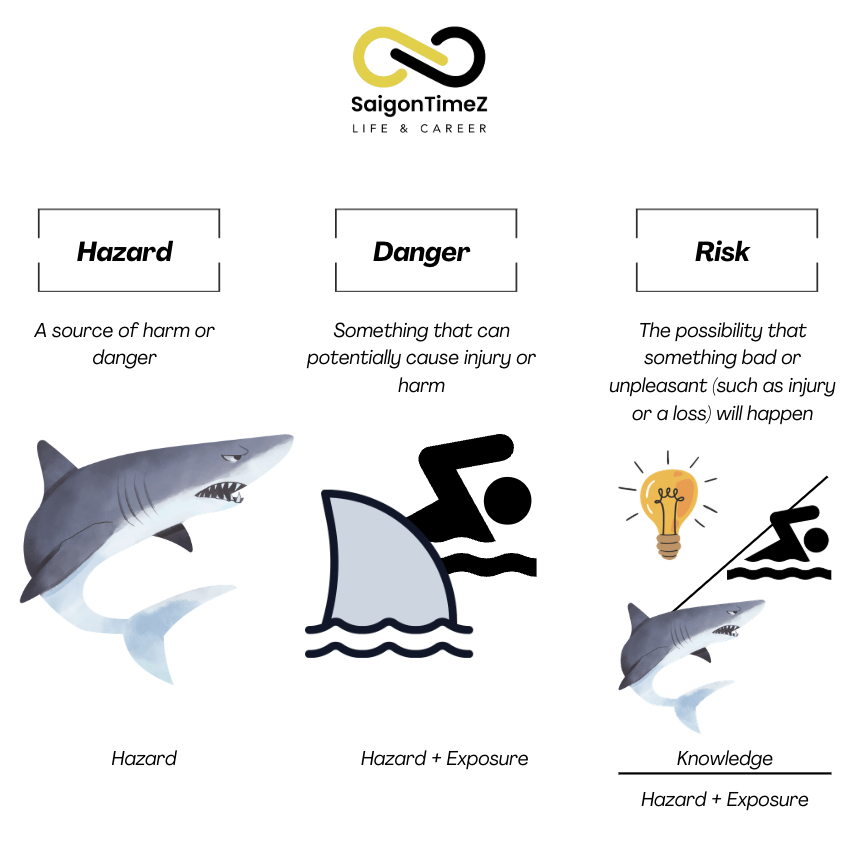
“Hazard indicates a source of harm or danger. For example, sharks are seen as hazards. Danger refers to something that can potentially cause injury or harm. In other words, danger appears when something or somebody has an exposure to hazards. Back to the example, sharks are hazards, and swimming near sharks is a danger. Risk is the possibility that something bad or unpleasant will happen. To make it clearer for you, risk reflects how much knowledge you have acquired about the interaction between hazards and dangers…” – He continued his speech with great wisdom.
I continued expressing my concern to my lecturer like a child was exploring a new world surrounding him. Indeed, I always remind myself that I am just a little boy on his life-long journey to explore the world and widen his horizon day by day.
“The most important thing is to be as knowledgeable as possible or do the best to acquire knowledge related to interested items before making any decisions or taking any actions. Am I right? – I innocently asked.
He smiled at me and replied: “Yes, you’re right…”
“Back to what we have discussed above, when you understand the meaning of Risk, you will see that the two groups of risks can tell us something more than their categories. Risks consist of Natural and People-related Risks. If natural risks give us the signal of the power of uncertainties about the nature we live with, people-related risks teach us more about humans’ limitations in life and at work. Clearly, humans are very small in the universe, and our knowledge about the world seems to be little; therefore, we are subjected to encounter a vast information asymmetry. The only thing we can do to well manage this kind of risk is to restrict their impact as much as possible. In reality, you can see the important role of insurance is emergently emphasized in developing countries and preferred in developed ones….” He continued explaining my concern.
I excitedly noted down what he mentioned quickly so that I could review and further research the topic at home by myself.
“When it comes to people-related risk, it will be a very long story. However, if you are an office worker, you can refer to the bowtie risk management methodology to imagine the risk source, the affected categories, and the risk impact.” – He repeated the idea twice and emphasized it.
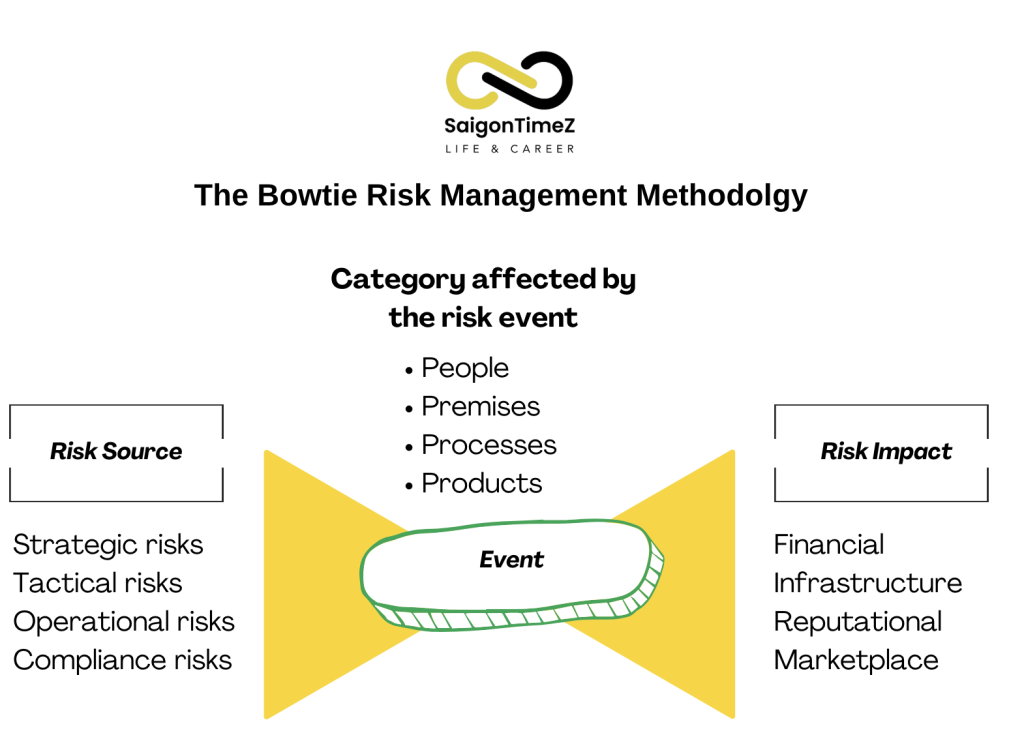
“Look at the model, you will easily recognize the risk sources such as strategic risks, tactical risks, operational risks, and compliance risks. Strategic risks imply the lack of Trend Knowledge, Tactical risks tell us the lack of the Art in resource utilization, Operational risks show us the deficiency of process management, and Compliance risks warn us of the tragedy of going against the laws or breaking the laws. And then, you can interpret and imagine what is going on when you encounter these risks. Right?” – He finished the explanation and expected that I would deeply and seriously think about the implications. I did it when I got home on that day and I wanted to give him a big thanks since he already solved a splitting-headache puzzle for me.
He is right! From his explanation, I can briefly derive what people should do when it comes to risk management.
- As for natural risks like earthquakes, accidents, fires, unemployment, etc., buying insurance can be a worthwhile option.
- As for people-related risks, just remind yourself of the formula below:
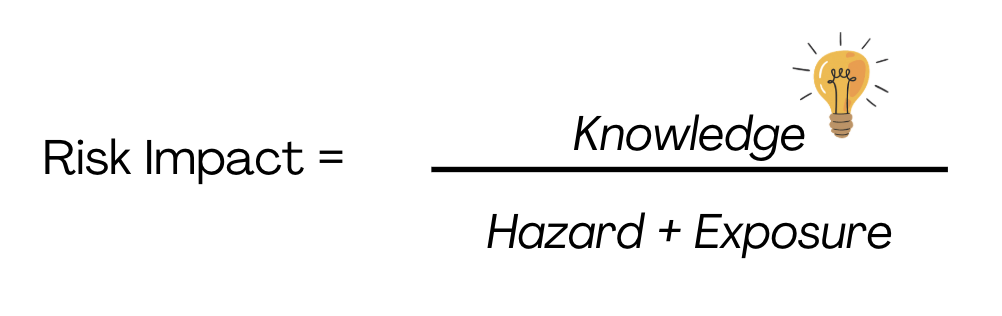
We cannot run away from the both of aforementioned risks in life, especially in the dynamic world; what we are supposed to do is to cope with them with our wisdom and great visions.
Hope my sharing can help!