


“Can You Really Change Someone?” is the question I have asked myself for years since I didn’t know whether or not somebody can actually change somebody else. It is said that a leopard cannot change its spots, however, that English proverb cannot fully reflect the implication of the Vietnamese one. In the original version in Vietnamese, the author used the phrase ” khó dời” which means “hard to change” in English. It’s “hard to change”, but “can’t change”. What insights are beyond the word “hard” in this situation? What can turn “hard” to ” be done” with a logical procedure in practice?

Can You Really Change Someone?
The Truth About Personal Transformation
First, it is necessary to emphasize that it is not a new topic, and there have been many explanations of the concept under different lenses. However, what is the core that guides proper actions to take?
Like my previous blogs, I am in favor of seeing things differently, laying everything on the table, or drilling down to the root causes, root definitions, or root reasoning of things. Finally, what I was learning from my instructor shed light on me. The ambiguity or confusion was gradually cleared and the explanation appeared right in front of me like I was watching a movie. All the plots were connected and formed an answer to my question. A big wow could be the best description of my emotions at that time.
According to McShane and Von Glinow (2005), MARS was proposed to give logical and rational explanations for individual behaviors. It could be used as the foundation for understanding somebody’s behaviors in life. In the theory, the key factors were revealed as below:
- Motivation
- Ability
- Role perception or Role clarity
- Situation factors
Among them, the elements of Motivation, Ability, and Role clarity were said to positively impact Individual behaviors and results, while the other element of Situational factors was strongly believed to moderate the relationships in the framework. The figure below presents the relationships among the aforementioned factors.
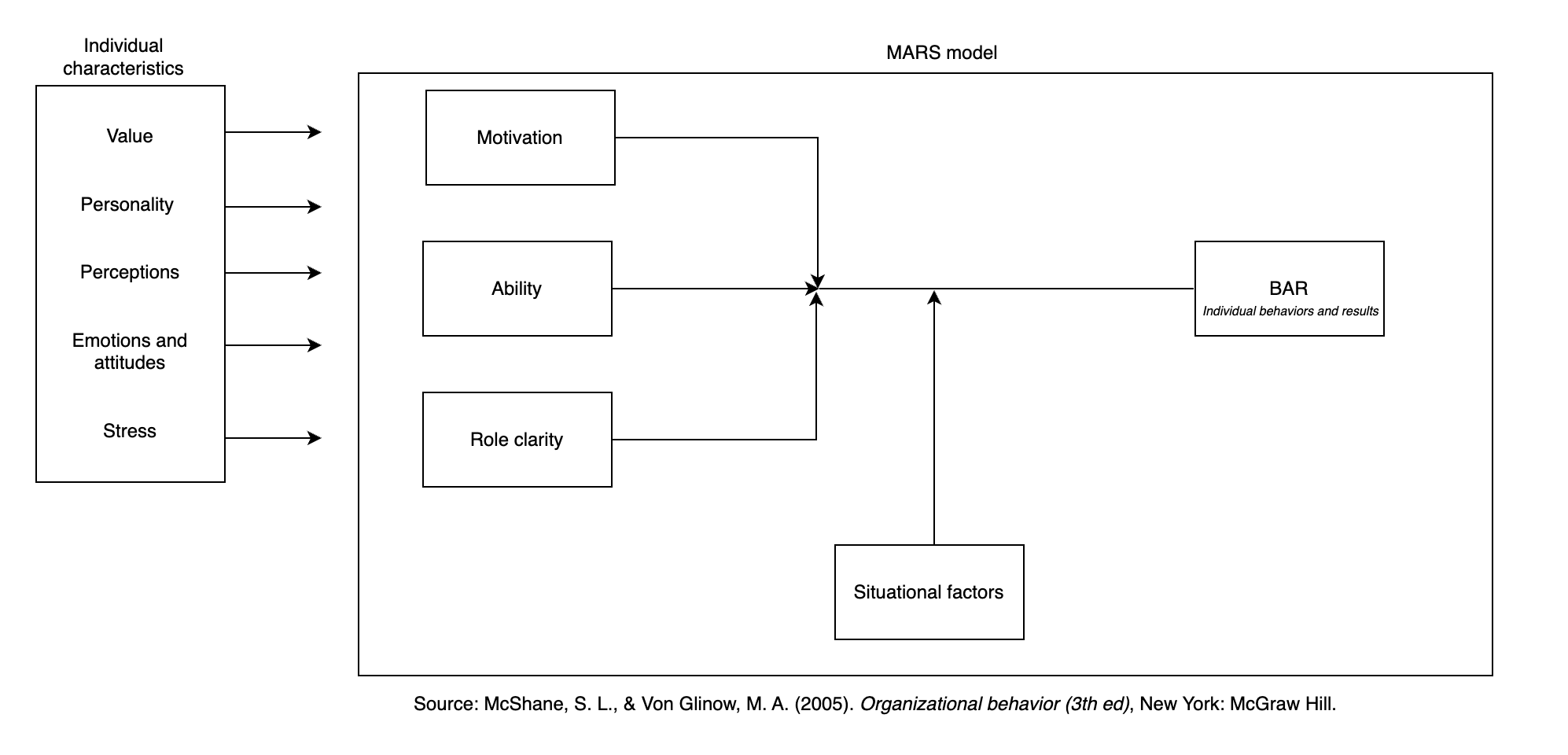
As I mentioned before, in the Vietnamese proverb, the author used the word “hard to” instead of “can’t” because the transformation requires more effort than we can imagine, and also needs both the right inputs and catalysts throughout the entire process. As clear as crystal, the puzzle will be solved when you know what directly impacts the motivation, ability, and role perception of somebody in certain situations. The findings vary from case to case in practice.
After exploring the key factors affecting individuals’ behaviors, my next questions revolved around what was standing behind one’s motivation, ability, role clarity, and even situational factors. The anonymous determinants should be brought into the spotlight.
First, the element of Motivation refers to one’s desires or one’s inner forces that drive somebody to a certain course of action. In physics, a force can be illustrated with direction, intensity, and persistence; which might affect one’s choice of behavior in reality. To make it clear, a matching task was done for a clearer explanation of the elements above.
- Direction represents your Goals in life. Actually, they should be SMART and be aligned with the Community Goals.
- Intensity is the amount of effort you can allocate to your goal attainment.
- Persistence shows how long you can sustain your effort to reach your goal.
Normally, people are always thinking about Goals or SMART Goals, but they miss the aspects of intensity and persistence. Therefore, they often go halfway towards reaching their goals.
Lesson learned: If you want to transform yourself or change behaviors, you are supposed to attain the right motivation for it. It means that there is not only direction but also intensity and persistence. If not, you will fail soon. Additionally, if you plan to change somebody’s behavior, you are recommended to explore their true motivation to trigger and remind them of it throughout the transforming process. It’s hard, but not impossible!
The second element is about “Ability”. It reflects one’s natural aptitudes and learned capabilities which are necessary for a certain behavior. Sometimes, you want to help your beloved ones, but you forget to count and analyze their abilities. Therefore, you easily get exhausted soon because they cannot completely follow your instructions or plans. Likewise, if you want to upgrade your behaviors and results, you have to understand your current abilities to make a better and more effective action plan.
Lesson learned: You are supposed to compare the current ability and the ability to acquire behavior, and then list down the gaps. Thanks to the listed gaps, you can consolidate your motivation by allocating proper effort and time to attain your goal with clear actions to fill gaps.
Besides, Role clarity or perception is very important since it reflects how well an individual understands what they should do accurately in different stages of life or career. An individual can perform well once he or she can perceive his or her role.
Lesson learned: In case, you want to make changes, you are required to answer the question “What are you supposed to fulfill in this stage?”. Recognizing your different missions in different stages will drive you to proper behaviors and results. If you are trying to change somebody, allow or bring them opportunities to learn and know their roles first.
Last but not least, environmental conditions account for the success of behavioral attainment. Normally, they are reasons to explain why people fail, they are the first issues that are mentioned as excuses for individuals’ failure. The situational factors include time, budget, physical work facilities, people, etc. However, it is a wrong mindset if you consider them as the main elements affecting your behaviors and results. Actually, they are just mediators only. Of course, without them, you might have greater challenges, but you can find alternatives or conquer them successfully if your “wants” are strong enough.
Lesson learned: Environmental conditions are obstacles on the way to reaching your goals. Learn more about them before you take any course of action so that you can nourish your motivation, draw a better action plan to enhance your ability, and then have a better perception of your role.
Out of the aforementioned factors, there is one more to notice. It is called Self-efficacy. The element reflects the amount of confidence you have toward attaining specific behaviors and results. There are three dimensions of it to mention: magnitude, strength, and generalizability.
- Magnitude refers to the level of task difficulty that you believe you can attain.
- Strength describes the level of conviction you have to deal with judgment around you and on the way to attain what you want.
- Generalizability is concerned with the extent to which the perception of your self-efficacy is limited to certain situations. In other words, it means how well you perceive your circumstantial limitations.
As I mentioned before, changing somebody is so hard to do since it requires a huge amount of effort, time, and a great understanding of that person from a doer.
However, if you are ready to give somebody a try. Remember to include the elements listed below in your course of action.
- Recognize the level of task difficulty you are going to take.
- Think about the scenarios you have to deal with judgment.
- Imagine your circumstantial limitations
If you finish the preparation steps, move on to
- Notice the environmental factors that affect your actions and the individual you are helping.
- Recognize and continuously remind yourself of your role and help that individual recognize and remember his/her role consciously.
- Know your motivation (goals, allocated effort, and time) and help that individual recognize his/her motivation (goals, allocated effort, and time)
- Keep improving your ability while supporting that individual to fill in his or her ability gaps.
If you reach the last step, congratulations! You have done good things for life! Keep doing your work, my friends!
References:
1) McShane, S. L., & Glinow, M. A. V. (2005). Organizational behavior: Emerging knowledge and practice for the real world. McGraw-Hill.
2) Wang, Y. Y., Lin, T. C., & Tsay, C. H. H. (2016). Encouraging IS developers to learn business skills: an examination of the MARS model. Information Technology & People, 29(2), 381-418.








Your article provides a clear and insightful explanation of the MARS model! The way you break down each component—Motivation, Ability, Role clarity, and Situational Factors—makes it easy to understand and apply in real-life situations. Thank you for sharing such valuable knowledge!