


When everything is going well, we seldom do real self-reflection since we assume it results from all our hard work and great effort. Of course, it is partially right! However, when things go wrong and become a hardship, we fall into our chaotic thoughts and start blaming destiny. Dozens of questions appear in awareness. The most noticeable could be: “Why is it destined to happen to me?”
Have you ever truly sat down to analyze your life calculations and plans to figure out all the relevant variables and find the solutions logically and scientifically? What do you think when I say that it’s all your choice?

I do not know why people separate life and work, people and product, “I” and “It”. There are still other aspects to consider because of their nature. I agree to some extent if somebody tells me something like that. However, I have a concern and would like to share it in this post with you. Firstly, please separate the cores and appurtenances. To get the big picture of surrounding things, we are supposed to understand the cores deeply; To better solve problems with certain contexts, we are meant to combine the cores and appurtenances to draw an effective solution. In other words, help yourself get the cores and be well aware of what happens in everyday life, then immerse yourself in specific situations to earn more experience.
DuPont Analysis and Its Implications for Life Choices
With the perspective of seeing “I” and “It” in the same way, which means you are a product in the market, you should learn how to make the right calculations to better your “I” in reality scientifically.
Let’s analyze the diagram below and answer 3 questions:
- When you want to improve yourself, what do you need to highly pay attention to?
- What can the numbers tell you in real life?
- From the numbers or figures, how can you make an effective self-development strategy?
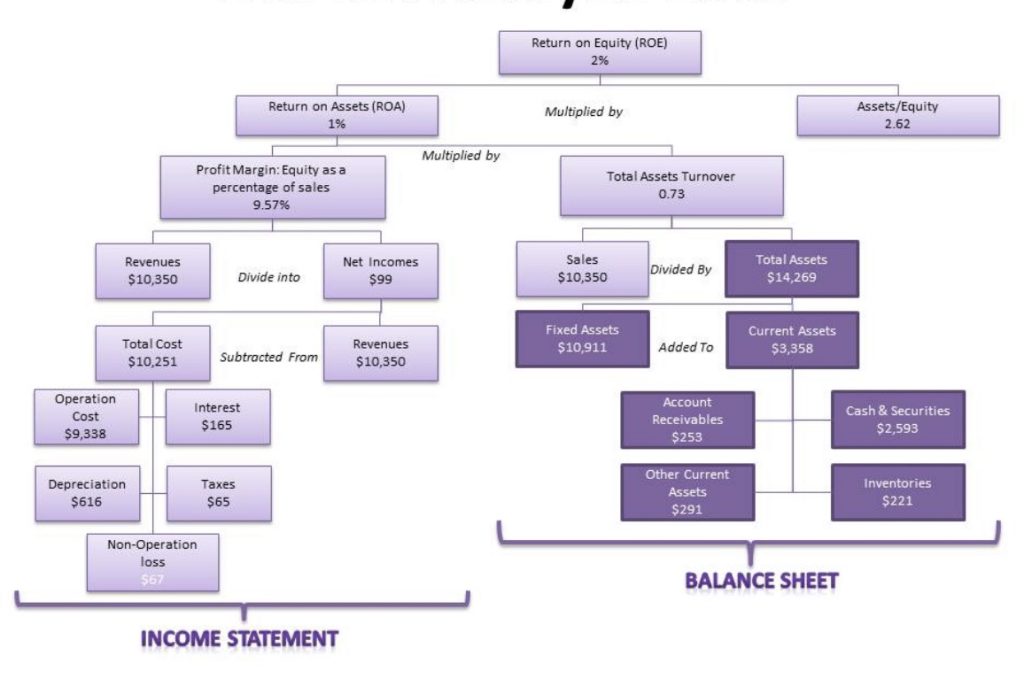
(Source: The Internet)
I can partially imagine your reaction after reading the diagram. You might say that what I already showed you is something on earth related to FINANCE, and you hardly find any relevance between the concept and your real daily situations. Am I right?
Let’s break the concept into smaller pieces to draw the connections between the concept and an individual’s life.
As I mentioned above, an individual can be considered ” a product” in the labor market. It means that that individual is bringing his or her competence and brand to the market and selling it for profit. To successfully construct the brand and better the competencies over time, that individual is highly supposed to deploy many strategies and action plans as well. In other words, that individual can be seen as a business owner to some extent. He or she needs to equip himself or herself with 2 key viewpoints including:
- The viewpoint of Assets: This viewpoint will help you to structure your assets including what you have at the moment by yourself and what you borrow from others. From that, you will know how to make good use of the leverage such as support from your social capital and loans.
- The viewpoint of Revenue and Cost: This viewpoint will help you imagine how the cash is in and out every day when you go to work and deliver the services to your employer and then earn money back as “Revenue of your competencies”. From that, you will recognize your price and value in the market and the necessary costs to increase or maintain that price or value. In particular, you can be highly aware of the profit you make in these transactions.
When an individual’s life goes wrong, it signals that he or she is applying the wrong strategies or plans to use his/her assets or manage the relationship between “Revenue” and “Cost”.
I will give you an example to simplify the aforementioned complicated concept.
PHASE 1: Being designed before being launched in the market (Done by Parents)
In this phase, you see big differences between a person and a product. As for a product, the creator can design its functions, features, benefits, and package. It means that all the good things are deliberately integrated into the product and it is 100% controllable and adjustable. However, when it comes to bringing a child into this world, it cannot follow that way indeed. From that, you can learn that there are many challenges when it comes to the time to introduce and sell that product in the labor market.
As for humans, that parents educate their children when they are young is incredibly important. It can crucially affect the progression in the later phases. This phase is the beginning of your investment which was done by your parents. Your parents accept BIG LOSS because they spend a lot of money on you for physical development, mental development, cognitive development, and emotional development without having any turnover. Your parents use all of their assets including their incomes and loans to build you up with the hope that your value will be increasing in the future. And one day, you will be the best seller in the labor market.
When you get back to the diagram, you can derive two things:
- In the income statement, you will find zero revenue and high costs.
- In the balance sheet, the assets cannot make any Turnover.
To support a child when he/she cannot make any right decisions for himself/ herself, what should parents pay attention to?
- Invest money into physical development by letting him/her play one sport along with practicing Yoga. Sports not only make the kid healthy and fit but also train his/her competitiveness in the long run. Yoga can help the kid be well aware of his/her mobility and inner voice.
- Accompany the kid throughout his/her general education and help him/her understand the insights of the 2 groups of subjects: Social Science Subjects and Natural Science Subjects. These subjects will help build and consolidate the kid’s cognitive foundation before he/she makes any decisions related to his/her major.
- Give the kid room and space to recognize his/her talents; then nurture them and make them thrive.
PHASE 2: Being designed before being launched in the market (Done by Kids & Parents)
Obviously, in this phase, kids grow up and they are supposed to learn how to make their own decisions to bring them back benefits and profits. They easily get lost and go wrong with oriental support from parents. In this phase, parents cannot play the role of a mentor or instructor anymore, they switch their roles to coaches, which means that parents are supposed to ask questions instead of giving specific answers.
Kids need to learn how to overcome and solve problems on their own. It is the golden time for kids to gradually develop their self-reliance and grit. Kids absolutely cannot make any clear achievements except exploring more and more life aspects and forming their mindsets.
Similar to the first phase, what you can derive from this stage could be below:
- In the income statement, you will find zero revenue and high costs. Carefully focus on the cost of prudent investments.
- In the balance sheet, the assets cannot make any Turnover at the moment. However, if the “assets” including Body, Mind, and Spirit are well structured, they can generate high turnover in the following time.
In the first two phases, if parents and kids have clear and relevant strategies as well as action plans, they can think about using financial leverage like educational loans.
PHASE 3: Interacting with the Working World and surviving first time life’s challenges (Done by Kids)
Parents are highly recommended to stand back and stand by and let their kids explore and deal with things by themselves. What parents can do is to advise if asked.
As for kids, they need to learn 2 things:
- The first thing is to well manage their cash flow IN & OUT. They had better calculate how much they need for necessities or needs (living expenses, rent/mortgage, bills, food, transport), recreation or wants (eating out, shopping, trips…), savings, and future investments. The rule here is 50-30-20.
- The second thing is to effectively assess their current assets to keep generating and bettering their turnover over time. The assets here can be Competencies, Social Capital, and Physical & Mental Health. In this stage, if any asset restructures are required, they need to do calculations properly to grasp chances timely. If parents already did well in the first two phases, kids will consult them during this phase.
PHASE 4: Sharpening the saw and always assessing their financial health
That nothing is forever is the best philosophy ever. The financial health should be assessed regularly and periodically to take proper actions on the way. During the stages of Growth and Maturity, the only thing they can do is to generate higher and more sustainable turnover as well as effectively manage the cash in and out throughout the time.
Do not remember that coming after maturity is declining; if they cannot acquire more competencies, widen their social networks, and maintain their health, they might deal with financial struggles later in their lives.
You might express what I mentioned above in another way, but what I want to deliver is to be true to yourself by looking into your crucial financial figures and decoding them precisely.








Simply wanna remark on few general things, The website style and design is perfect, the subject material is very superb. “The sun sets without thy assistance.” by The Talmud.
Whats up very cool website!! Guy .. Beautiful .. Superb .. I’ll bookmark your website and take the feeds additionally…I am happy to search out numerous helpful information right here in the put up, we’d like work out more strategies in this regard, thank you for sharing. . . . . .
I went over this website and I conceive you have a lot of wonderful info , saved to my bookmarks (:.
Thanks for sharing. I read many of your blog posts, cool, your blog is very good.