

The Year 2025 has showcased many uncertainties regarding natural disasters, economic crises, and wars worldwide. The deliberate and non-deliberate attacks signaled various causal relationships in a multidisciplinary context. However, these uncertainties are likely to be partially explained through two powerful economic formulas that a few of us were taught at school. The two calculations are associated with GDP (Gross Domestic Product) and GNP/GNI (Gross National Product or Gross National Income). The interrelationship between these two constructs can offer a variety of implications to individuals, businesses, educational institutions, and countries.

Source: https://yumyum-mama.com/
What are the stories beyond the formulas of GDP and GNP?
GDP and GNP are noted as the value of goods and services produced within a country’s borders and the value of goods and services produced by a country’s residents, respectively. Therefore, the influential factors are highlighted in the two formulas with many implications. First, in the formula of GDP, “consumption”, “investments”, “government expenditure/ spending”, “export”, and “import” are accounted for the total value produced within a nation’s borders; whereas, GNP can be the sum of GDP and NIFA (net income from abroad). Importantly, NIFA can be calculated by subtracting the income earned by foreign residents within a country from the income earned by the country’s residents from foreign sources.
Net Income from Abroad = Income Earned by Residents from Abroad – Income Earned by Foreigners within the Country
Based on the two calculations, some questions might be elicited to clarify what is happening on a daily basis. Below are the leading questions:
Q1. What factors affect “consumption”?
Q2. What factors affect “investments”?
Q3. What factors affect “governmental expenditure/ spending”?
Q4. What factors affect “export and import”?
Q5. What can tell you about “negative” NIFA, GNP < GDP, or GNP > GDP?
Q6. What is the role of Education & Learning in this context?
If an individual is taught about the formulas without any comprehensive explanations, s/he will perceive them as economic formulas, nothing more, nothing less. However, if the formulas come with clear explanations and influential factors, “mysteries” can be gradually unveiled. Let’s use the 5WHY method to further explore what might be behind these factors.
- CONSUMPTION can be significantly influenced by VAT, Income (1) + PIT, Inflation, and Credit Interest Rate.
- INVESTMENTS can be significantly influenced by COGS (2), Geopolitics, Taxes, and Operational Costs (3).
- GOVERNMENTAL SPENDING can be significantly influenced by Interest Rate, Fiscal Policies, Tax Collection, and Inflation.
- EXPORT / IMPORT can be significantly influenced by Tariffs, Trade Wards, and Global Supply Chain (4).
Following the above discussions, the complex mechanisms behind the GDP formula are not “easy stories.” As an ordinary person, what can you contribute to the big picture?
Equally important, GNP can be mentioned in conjunction with GDP, with an emphasis on the income earned by residents from abroad and the income earned by foreigners within the country. The perspective refers to the exploitation capability of residents in the foreign market and foreigners within the market. If NIFA is negative and GNP < GDP, it highlights the opportunities for FDI. Conversely, a significant amount of foreign assets held by residents is underscored. As an ordinary person, what can you do to contribute to the negative/positive NIFA?
Obviously, we are too small in our nation’s economic big picture. What you are thinking, discussing, and doing is still small in the context of a national-level solution. Many of us opt to ignore the calculations and return to the familiar story of earning a living. There should not be a distinction between “Right” and “Wrong” in this context. However, there is a saying that “Every little bit counts.” What could be your contributions to your nation? The answer is “Your education and Your Patents“.
The factors that are numbered in the list of key drivers are the ones you can do with your “true” and “high-quality” education. Moreover, the more patents you get, the more you contribute to your nation’s big picture. The next question should be, “What is the role of educational institutions in developing the talents for a country?”
Chankseliani et al. (2021) used to describe the duties of universities as educating and developing human potential, advancing people’s understanding and knowledge about the world, and driving changes and improvements.
The big differences among the countries worldwide are related to their educational systems. Education is not for fun or recreational purposes. Education aims to explore and release as much potential of an individual as possible. Education should not revolve around one nation, but the connection and position of that nation in a network of other countries. How can “education” fulfill its mission in a nation’s big game? The answer is “the CONSISTENCY among the educational system from K12 to HEIs (higher education institutions) aligned with the nation’s missions and visions”.
Below is an example to illustrate what education can do with K12 students.
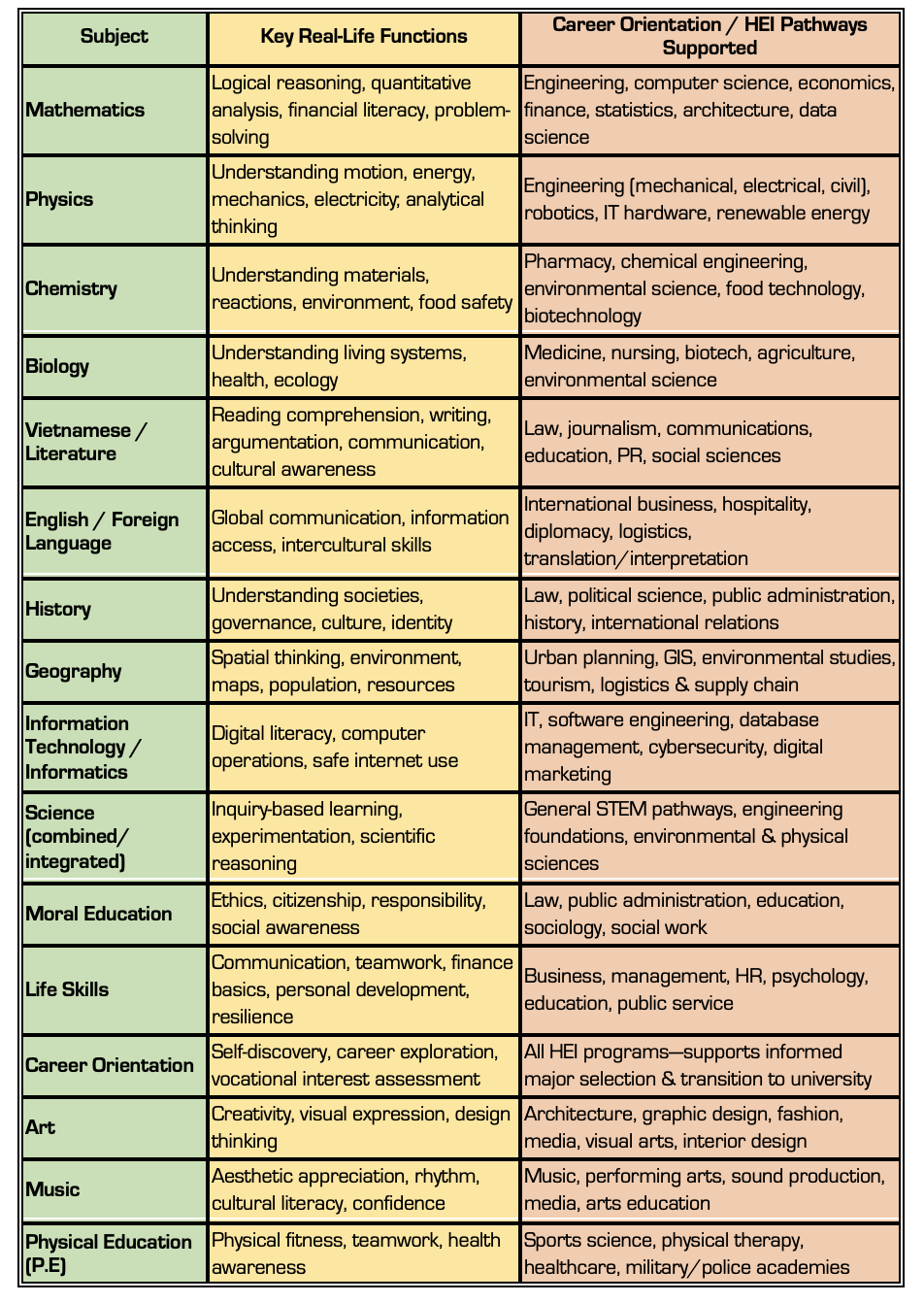
Source: The Internet
K-12 students are expected to complete their general education before entering their professional education and training at HEIs. However, a few of them can be well aware of what they are learning in school. Once they cannot recognize the objectives of the school subjects, they won’t acquire the fundamentals or key competencies for their future career. What are you supposed to do as an educator or teacher?
Higher education institutions are destined to further their education so that they can be well-trained for their desired jobs. What a typical university student is expected to obtain is:
- to build up and develop technical knowledge and skills
- to improve their teamwork spirit and interpersonal skills
- to form their critical thinking and soft skills
- and especially to enhance their research skills
If all students were aware of what they were doing in school at any given moment, they would be eligible and skilled enough to contribute to their nation’s growth and development, thereby changing the world. It is the starting point for the two powerful economic formulas mentioned above.
Without Proper Education, there will be no changes and development!