As a College Visiting Instructor for nearly 7 years, I have received numerous questions about Procrastination from my in-charge students of different intakes. They gave much heed to procrastination and the reasons beyond this common phenomenon among students and office workers. When they came to me with a considerably worried look, they seemed unable to express what they got stuck with their actions completely. I know that I am not an expert in this field. However, I started reading more and more materials about this topic with the hope of helping them someday. If not, at least, I have better knowledge and understanding of the problem and can support the younger generations in need.
When it comes to Procrastination which is a catchword, there exist abundant quotes and sayings. Nevertheless, they sound catchy but lack of action-oriented guidance or guidelines.
To support myself in exploring the interventions associated with procrastination, I read a few prestigious relevant journals from Scopus which is considered one of the greatest sources of wisdom and contributed knowledge worldwide. I was quite impressed with the research of María Rosa Salguero-Pazos and Salvador Reyes-de-Co ́zar *. They gave their readers a systematic review related to the topic of Academic Procrastination and the remarkable interventions. Personally, office workers can also take advantage of the research implications to cope with their procrastination symptoms in reality.
According to Salguero-Pazos et al (2023), there are various factors leading students to their procrastination status. However, the author emphasized the three different approaches she learned from her literature review including:
- Psychological approach,
- Personal approach,
- and Pedagogic approach.
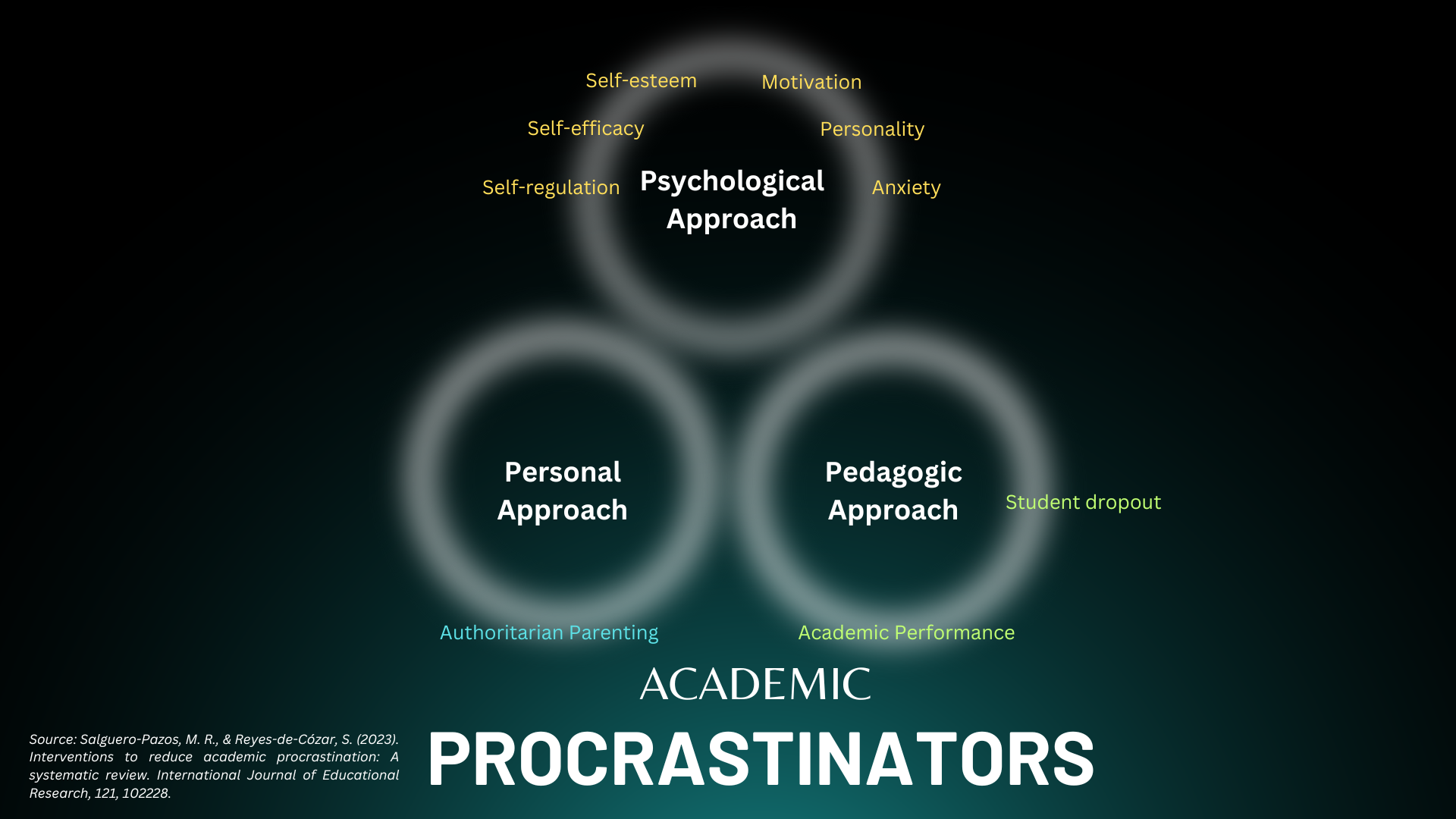
In the research, the psychological approach was mainly focused on and explained in detail with its 6 core dimensions such as:
- Self-regulation refers to the ability to well manage one’s thoughts, emotions, and actions through a series of personal strategies, allowing individuals to achieve their objectives and avoid undesired results. Self-regulation is the central dimension that appeared in 90% of the reviewed articles in the research.
- Self-efficacy reflects the personal perception or belief of one’s capabilities in certain situations. The review found that self-efficacy comes second in the results, with 28.1% co-occurrence.
- Motivation describes the internal factors that can determine one’s actions. It is one of the top three focused dimensions, with 21.8% co-occurrence.
- Self-esteem emerges as one of the interventions driving one’s procrastination. It shows how they feel or think about themselves. In other words, it consists of perceptions, thoughts, feelings, and evaluations of oneself. Additionally, self-esteem focuses on one’s fear or self-doubt. Low self-esteem people are vulnerable to their surroundings, especially irrational beliefs. The concept appeared in 18.7% of the reviewed articles.
- Personality, in the research, alludes to Perfectionism. It is the fundamental trait of academic procrastinators. They are always looking forward to perfectionism in their assigned tasks and work. They have to suffer from their self-criticism regularly and deal with their fear of being not perfect or inferior to their peers. 6.2% of the reviewed articles mentioned and analyzed this concept as a crucial intervention of procrastination.
- Anxiety obtains the least percentage of co-occurrence in the reviewed articles, it’s only about 3.1%. Anxiety is described as a mental state of restlessness or extreme insecurity.
Completing reading the journal, I seriously contemplated procrastination in general and academic procrastination in particular. I started gathering pieces of information and data from my observation. The big picture was gradually drawn and finally finished in front of my eyes. In the picture, I recognized that individuals were in the center and they were surrounded by external factors called interventions. They seemed to struggle to break out of that terrible trap of their lives. However, it looked not an easy job at all. To effectively control those factors, they are supposed to be well aware of the aspects mentioned below:
- Knowledge about what they are dealing with: a series of learning actions to develop their expertise in specific fields and about delegated tasks. The theoretical and empirical acquisition should go along with each other on the journey of their horizon widening.
- From the knowledge of what they dealing with; people can gain a better awareness of their current and potential capabilities and their personalities, especially their fear and self-doubt: Normally, people make wrong self-evaluations and carry out irrational fear because of being lack of knowledge. In other words, being deficient in knowledge about themselves in given situations easily leads them to self-doubt, and then they easily end up what they are doing with mistrust.
- Recognizing and maintaining driving forces that lead them not to build the “later-to-do” list: On the journey of doing something new, discouragement and hesitation always appear as challenges for the doers. Understanding and nourishing motivation is super important, it can be considered as an effective reminder. Whenever individuals get bored of what they are pursuing and tend to postpone their actions, immediately use the forces to remind themselves of why they started before.
In general, procrastination is led by different dimensions. From the aforementioned aspects, individuals are highly supposed to regulate their thoughts, feelings, and actions to conquer challenges and difficulties in study and at work; then divert themselves to a more positive path that leads them closer to their objectives or goals. In other complicated situations, remember to refer to other approaches such as Personal and Pedagogic ones.
To sum up, whenever you say “later”, stop for a while and immediately think about what might be wrong and stop you from doing it now. “Later” is because of knowledge, gaps between your current capabilities and the expected performance, or having no driving forces. Think about it and then get the answers by yourself, don’t forget that “Later” is the best friend of “Never”.
* Reference: Salguero-Pazos, M. R., & Reyes-de-Cózar, S. (2023). Interventions to reduce academic procrastination: A systematic review. International Journal of Educational Research, 121, 102228. DOI: 10.1016/j.ijer.2023.102228