


It is said that Social Media has become extremely familiar with every single person nowadays. We get updated information from Social Media, learn something new from Social Media, show our positive and negative emotions on Social Media, expand our network on Social Media, etc,… In the beginning, it came with so many advantages because it seemed to open a new horizon for us. However, as time goes by, there appear many disadvantages and consequences e.g. Chaotic Information, Hoaxes, and Wrongly Perceived Input. From that, hundreds of tragedies come up with provoking thoughts. The main question of mine is What influences our perceived input?

Context 1: How does “Perceived” drive your buying decision?
In this context, you can see your role as a consumer. When a consumer decides to purchase a thing, he or she will go through Seven Common Stages such as:

During the process, a consumer needs quite a lot of information to support his or her purchasing decision. If you look into it, you will learn that his or her sacrifice to get the product that he or she needs or wants will consume much time and effort as well. This buying process will be remarkably influenced by “Perceived Value“.
Perceived Value is the value of a product that a typical consumer perceives before deciding to buy it. It is a complex combination of Perceived Quality, Intrinsic Attributes, Extrinsic Attributes, High-Level Abstractions, and Perceived Sacrifice. This mixture tells us that there do not exist 100% rational or logical decisions on earth. Everything is just relatively rational and logical no more or less.
Look at the figure of A Means-End Model Relating Price, Quality, and Value below:
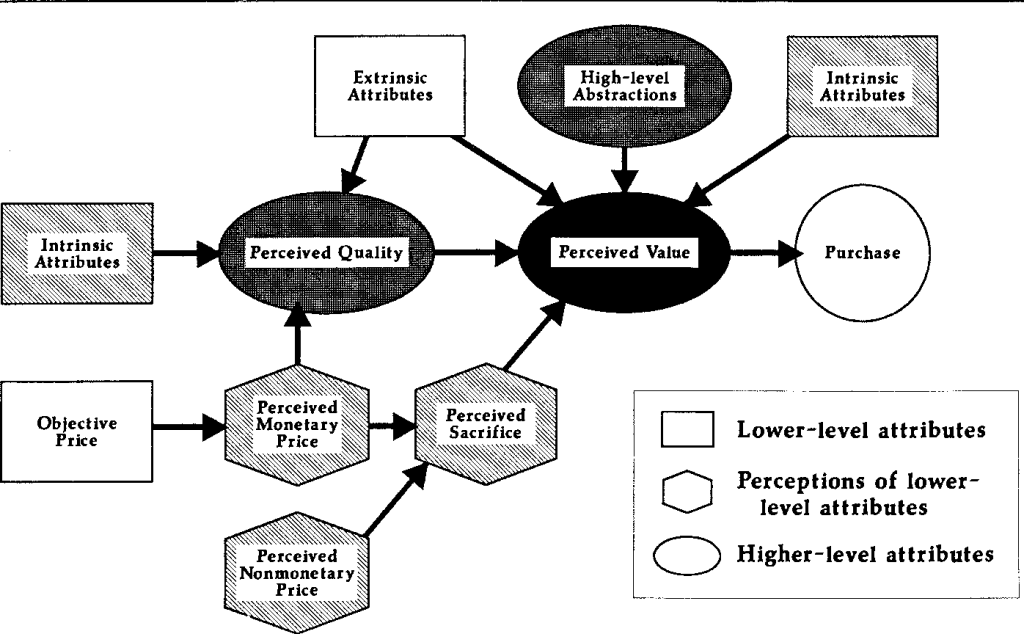
(Valarie. A.Z, 1988. Consumer Perceptions of Price, Quality, and Value: A Means-End Model and Synthesis of Evidence. Journal of Marketing. Vol.52.2-22)
Based on the model, you can learn that the value you actually perceive is contributed by Extrinsic Attributes (e.g. Level of Advertising, Brand Name), Intrinsic Attributes (e.g. Technical Specifications used to make a product), High-Level Abstractions (e.g. Emotional Payoff), Perceived Sacrifice (e.g. Time, Money, and Effort to acquire a product), and Perceived Quality. (e.g. Intrinsic & Extrinsic Attributes, and Perceived Monetary Price which varies from consumer to consumer due to the availability of other cues to quality, price variation, and product quality variation within a category of products, and the ability of consumers to detect and recognize the quality variation in a class of products.)
As for the first two elements, if you are a consumer, you need to know when you rely more on intrinsic attributes or extrinsic attributes. According to the author, she mentioned:
- When intrinsic attributes have a higher predictive value than extrinsic, At the point products are consumed, and When intrinsic attributes are search attributes in pre-purchase situations; consumers will depend on intrinsic attributes rather than extrinsic ones.
- On the contrary, when intrinsic cues are not available in the initial purchase situations when evaluation of intrinsic attributes requires more effort and time when quality is difficult to detect; consumers will depend on extrinsic attributes rather than intrinsic ones.
As far as the other elements are concerned, it is not easy to well and radically manage the ways they are perceived by different consumers. In general, deciding to buy a product is so complicated and is not 100% rational or logical as you thought. Everything is based on what you perceive about the product. Perceived is something more powerful than the nature of a product!
Context 2: How does “Perceived” drive your life?
2024 has already come and is completing the great change of life in all aspects. It seems that the ways you are making things, promoting things, and selling things gradually and then rapidly changed. During this period of the economic crisis, the world actually took off his old clothes and put on a new one. Along with it, forces to change for each individual on earth are definitely inevitable. This cycle of Introduction, Growth, Maturity, and Decline happens over and over again. After each certain cycle, new things appear, and life is upgraded.
Recently, I have heard a bunch of stories from my acquaintances. They shared pieces of information about their industries and society with me; they showed me their great concerns about the uncertainties of life and work. I could recognize their burdens and a thousand calculations in their head. And I started wondering what was happening in this life. What makes people like that? What probably drives them distressed?
And then what I learned is all around the word – PERCEIVED!
With the denotative definition of the word, you can learn that “Perceived” might reflect your mindset, experiences, and worldview. In other words, it is said that your deep or comprehensive understanding and awareness of something will help you perceive things better.
If you think of your decision as a kind of production, I reckon that you might know the abbreviation of I.P.O which stands for Input, Process, and Output. To effectively process what you have got and make your wanted output, the importance of your INPUT is highly appreciated.
How can you better your “PERCEIVED” Input?
There exist 2 concepts to bear in mind:
- Quantitative and Qualitative: Most of the time, people just prefer qualitative study rather than quantitative study. Therefore, when dealing with problems, they cannot measure the importance and impact of the issues and then they cannot figure out how impactful they are to their lives and work. As a result, they fool around their problems without any clear and radical solutions. In conclusion, to perceive things effectively is to be able to measure what you try to perceive.
- Anchoring Effect along with In-Group Influence: Every daily decision of yours might be influenced by your social network e.g. your family, friends, colleagues, managers, or even neighbors who are counted as your In-group members. However, you should bear in mind that they might have their own biases against what you are encountering. If you solely depend on their advice or suggestions, your perception might be wrong. Also, the Anchoring Effect can be a great enemy of an effective solution or decision. It is a kind of art of negotiation that many salespeople are using in the world to limit and narrow down your perception so that they can play with your own decision.
Now, forget all the academic things I have mentioned in the previous part. I would like to haul what you are doing for a while and observe your surroundings.
You might be at a coffee shop, at your workplace, at home, or somewhere on the earth. Watch and think about the behaviors of people around you. They might show you their happiness, anxiety, fear, anger, or hope for the same thing. For example: you might find many controversial comments on social media about something like buying luxurious items, some characters in a game show, a scene in a movie, or just a bill at a fine-dinner restaurant. Through a series of serious and fierce debates, have you ever questioned why those people share so different thoughts that you will get confused every time you encounter them?
The answer to this phenomenon is all about how each individual perceives the issues. What makes their perception closer to accuracy?
There are 3 steps to strictly follow:
Step 1: Choose the most proper method to define and measure criteria related to your decision-making
Step 2: Gather necessary and sufficient data to prevent Anchoring Effect
Step 3: Well manage the contribution from related people to avoid In-Group Influence
So, when you are deciding to buy a specific item or to make a certain decision; your perceived input will play a very important role. It can divert your attention to Pain or Pleasure. If the pain or the pleasure is too much or over-controlled, your choice might be a disaster. Not only helping your perceived input be impactful enough to make decisions but also keeping it enough and objective for you is the hardest job ever!








Hi! I’m at work surfing around your blog from my new apple iphone!
Just wanted to say I love reading your blog and look forward to
all your posts! Keep up the outstanding work!
I?ll immediately grasp your rss feed as I can not to find your email subscription link or e-newsletter service. Do you have any? Please permit me know so that I may subscribe. Thanks.
My developer is trying to convince me to move to .net from PHP. I have always disliked the idea because of the costs. But he’s tryiong none the less. I’ve been using WordPress on various websites for about a year and am nervous about switching to another platform. I have heard good things about blogengine.net. Is there a way I can import all my wordpress posts into it? Any kind of help would be really appreciated!
Also a thing to mention is that an online business administration training is designed for people to be able to effortlessly proceed to bachelors degree courses. The 90 credit education meets the lower bachelor college degree requirements so when you earn the associate of arts in BA online, you will get access to the modern technologies in this field. Some reasons why students have to get their associate degree in business is because they may be interested in this area and want to receive the general education necessary previous to jumping right into a bachelor education program. Thx for the tips you really provide within your blog.
I can’t express how much I appreciate the effort the author has put into writing this exceptional piece of content. The clarity of the writing, the depth of analysis, and the plethora of information offered are simply remarkable. Her zeal for the subject is apparent, and it has definitely struck a chord with me. Thank you, author, for sharing your insights and enhancing our lives with this incredible article!
Thanks for your post on the vacation industry. I will also like contribute that if you are a senior thinking about traveling, it is absolutely important to buy travel insurance for elderly people. When traveling, golden-agers are at greatest risk of experiencing a health emergency. Having the right insurance policies package for the age group can look after your health and give you peace of mind.
The crux of your writing while appearing reasonable at first, did not sit very well with me personally after some time. Somewhere within the paragraphs you actually were able to make me a believer but only for a while. I however have a problem with your leaps in logic and you might do nicely to help fill in those breaks. In the event that you can accomplish that, I could undoubtedly end up being impressed.
I will immediately grab your rss as I can not find your e-mail subscription link or e-newsletter service. Do you’ve any? Please let me know in order that I could subscribe. Thanks.
I’m typically to running a blog and i actually respect your content. The article has really peaks my interest. I’m going to bookmark your web site and keep checking for brand new information.
In these days of austerity and also relative stress and anxiety about having debt, many people balk contrary to the idea of employing a credit card to make purchase of merchandise or maybe pay for any occasion, preferring, instead only to rely on the actual tried along with trusted method of making settlement – hard cash. However, if you’ve got the cash there to make the purchase completely, then, paradoxically, that is the best time for you to use the credit cards for several factors.
This article offers a fascinating perspective on the subject. The depth of research and clarity in presentation make it a valuable read for anyone interested in this topic. It’s refreshing to see such well-articulated insights that not only inform but also provoke thoughtful discussion. I particularly appreciated the way the author connected various aspects to provide a comprehensive understanding. It’s clear that a lot of effort went into compiling this piece, and it certainly pays off. Looking forward to reading more from this author and hearing other readers’ thoughts. Keep up the excellent work!
naturally like your website however you have to test the spelling on quite a few of your posts. Several of them are rife with spelling problems and I in finding it very troublesome to tell the reality then again I?ll certainly come again again.
Wow, fantastic weblog structure! How long have you been blogging for? you make blogging glance easy. The full glance of your site is fantastic, as neatly as the content material!
Great article! I appreciate the clear and insightful perspective you’ve shared. It’s fascinating to see how this topic is developing. For those interested in diving deeper, I found an excellent resource that expands on these ideas: check it out here. Looking forward to hearing others thoughts and continuing the discussion!
Hello there, You have done an excellent job. I will certainly digg it and personally recommend to my friends. I am confident they will be benefited from this website.
Heya just wanted to give you a brief heads up and let you know a few of the images aren’t loading properly. I’m not sure why but I think its a linking issue. I’ve tried it in two different web browsers and both show the same results.
We stumbled over here from a different page and thought I might check things out. I like what I see so now i am following you. Look forward to exploring your web page repeatedly.
Thanks for the recommendations shared on your own blog. Yet another thing I would like to state is that losing weight is not supposed to be about going on a dietary fad and trying to reduce as much weight as possible in a few days. The most effective way to lose weight is by getting it little by little and following some basic ideas which can make it easier to make the most from a attempt to drop some weight. You may learn and already be following some of these tips, yet reinforcing know-how never hurts.
Thanks for sharing your ideas. One thing is that students have a solution between federal government student loan along with a private education loan where its easier to select student loan debt consolidation loan than over the federal education loan.
I loved as much as you’ll receive carried out right here. The sketch is tasteful, your authored subject matter stylish. nonetheless, you command get got an shakiness over that you wish be delivering the following. unwell unquestionably come more formerly again since exactly the same nearly very often inside case you shield this increase.
As I website possessor I believe the content material here is rattling fantastic , appreciate it for your efforts. You should keep it up forever! Good Luck.
Have you ever thought about publishing an e-book or guest authoring on other sites? I have a blog centered on the same ideas you discuss and would love to have you share some stories/information. I know my viewers would enjoy your work. If you’re even remotely interested, feel free to shoot me an e-mail.
I have figured out some significant things through your blog post post. One other point I would like to express is that there are lots of games that you can buy which are designed in particular for toddler age little ones. They consist of pattern recognition, colors, family pets, and shapes. These normally focus on familiarization rather than memorization. This helps to keep a child engaged without having a sensation like they are learning. Thanks
In accordance with my study, after a the foreclosure home is bought at an auction, it is common for that borrower to be able to still have a remaining unpaid debt on the bank loan. There are many financial institutions who make an effort to have all service fees and liens repaid by the future buyer. However, depending on selected programs, polices, and state legal guidelines there may be many loans that are not easily settled through the transfer of lending options. Therefore, the obligation still rests on the debtor that has got his or her property in foreclosure process. Many thanks for sharing your notions on this blog site.
Thanks for the recommendations you have discussed here. One more thing I would like to say is that pc memory needs generally rise along with other breakthroughs in the know-how. For instance, whenever new generations of cpus are introduced to the market, there is certainly usually a related increase in the size and style preferences of both computer memory and also hard drive room. This is because software program operated by simply these processors will inevitably rise in power to leverage the new technological know-how.
Excellent website. A lot of helpful info here. I?m sending it to some friends ans also sharing in delicious. And of course, thank you on your sweat!
Sweet blog! I found it while browsing on Yahoo News. Do you have any suggestions on how to get listed in Yahoo News? I’ve been trying for a while but I never seem to get there! Many thanks
Thanks for any other informative website. Where else may I am getting that kind of information written in such an ideal method? I’ve a venture that I’m just now working on, and I’ve been at the glance out for such info.
Thanks for your blog post. What I would like to add is that laptop or computer memory ought to be purchased if your computer can’t cope with anything you do with it. One can add two good old ram boards having 1GB each, by way of example, but not certainly one of 1GB and one with 2GB. One should always check the car maker’s documentation for one’s PC to make sure what type of ram is necessary.
I do not even know how I stopped up right here, however I assumed this publish was once good. I do not realize who you’re but certainly you’re going to a well-known blogger in the event you aren’t already 😉 Cheers!
Generally I do not read article on blogs, but I wish to say that this write-up very forced me to try and do so! Your writing style has been surprised me. Thanks, quite nice post.
I appreciate the humor in your analysis! For additional info, visit: FIND OUT MORE. What do you think?
whoah this blog is magnificent i love studying your articles. Keep up the great paintings! You already know, a lot of people are looking around for this information, you could help them greatly.
Pretty section of content. I just stumbled upon your weblog and in accession capital to assert that I acquire in fact enjoyed account your blog posts. Any way I will be subscribing to your feeds and even I achievement you access consistently rapidly.
Heya just wanted to give you a quick heads up and let you know a few of the images aren’t loading correctly. I’m not sure why but I think its a linking issue. I’ve tried it in two different browsers and both show the same results.
Great write-up, I?m regular visitor of one?s website, maintain up the nice operate, and It’s going to be a regular visitor for a lengthy time.
This is a excellent web page, might you be interested in doing an interview regarding how you created it? If so e-mail me!
Hi there! I know this is kind of off topic but I was wondering which blog platform are you using for this site? I’m getting fed up of WordPress because I’ve had issues with hackers and I’m looking at alternatives for another platform. I would be fantastic if you could point me in the direction of a good platform.
I’ve observed that in the world the present day, video games include the latest fad with kids of all ages. Occasionally it may be extremely hard to drag your kids away from the games. If you want the best of both worlds, there are many educational video games for kids. Great post.
Good ? I should definitely pronounce, impressed with your website. I had no trouble navigating through all the tabs and related information ended up being truly easy to do to access. I recently found what I hoped for before you know it in the least. Quite unusual. Is likely to appreciate it for those who add forums or anything, website theme . a tones way for your client to communicate. Excellent task..
Magnificent beat ! I would like to apprentice while you amend your website, how could i subscribe for a blog website? The account helped me a acceptable deal. I had been tiny bit acquainted of this your broadcast offered bright clear idea
Hey there! Do you know if they make any plugins to protect against hackers? I’m kinda paranoid about losing everything I’ve worked hard on. Any recommendations?
Hmm is anyone else experiencing problems with the images on this blog loading? I’m trying to figure out if its a problem on my end or if it’s the blog. Any suggestions would be greatly appreciated.
hello there and thank you for your info ? I have certainly picked up anything new from right here. I did however expertise a few technical issues using this site, as I experienced to reload the web site lots of times previous to I could get it to load correctly. I had been wondering if your web host is OK? Not that I am complaining, but slow loading instances times will often affect your placement in google and could damage your high-quality score if advertising and marketing with Adwords. Anyway I?m adding this RSS to my e-mail and can look out for a lot more of your respective exciting content. Ensure that you update this again very soon..
Nice post. I was checking constantly this blog and I am impressed! Very helpful information specially the ultimate section 🙂 I care for such information a lot. I was seeking this certain info for a very lengthy time. Thanks and best of luck.
Thanks for revealing your ideas here. The other point is that each time a problem takes place with a laptop or computer motherboard, persons should not go ahead and take risk connected with repairing the item themselves for if it is not done correctly it can lead to permanent damage to the whole laptop. It is usually safe just to approach the dealer of that laptop with the repair of the motherboard. They’ve already technicians that have an expertise in dealing with laptop motherboard troubles and can have the right diagnosis and undertake repairs.
Thank you for another informative website. Where else could I get that kind of information written in such an ideal way? I have a project that I’m just now working on, and I have been on the look out for such info.
Music began playing any time I opened this web page, so frustrating!
I have read a few good stuff here. Definitely worth bookmarking for revisiting. I surprise how much effort you put to make such a wonderful informative site.
The very crux of your writing whilst appearing reasonable in the beginning, did not sit properly with me after some time. Someplace within the sentences you were able to make me a believer unfortunately only for a short while. I however have got a problem with your jumps in logic and you would do well to fill in all those breaks. In the event that you actually can accomplish that, I will definitely be amazed.